Building with AI in 2026: What Three Years Taught Me
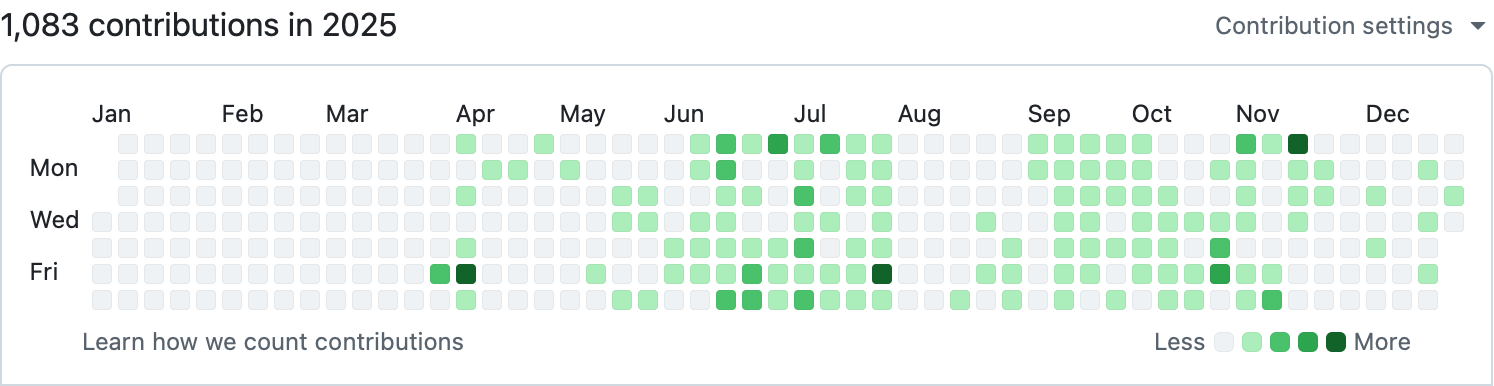
The GitHub contributions graph above shows I shipped code almost every week in 2025. Each green square represents iteration—trying, breaking, fixing, learning. Some commits shipped production features. Others were experiments that taught me what to avoid next time. The projects behind those contributions are what this post unpacks: the systems, the lessons, the momentum that builds when you show up consistently.
The Foundation: 2023-2025 in Review
2023 was about curiosity. I experimented with prompt engineering and gen AI tools.
2024 was about riding the wave. GPT-4, Claude 2, Claude 3, Gemini. Every few months, it brought something that made the previous version feel ancient. I went from a cautious experimenter to an active user, though I'm still mostly reacting.
2025 was about building. Apps, workflows, and systems that deliver value.
The Four Lessons That Changed Everything
The Humility of Not Knowing
I operated with a quiet assumption: I needed to know enough before I could start. Enough about code. Enough about APIs. Enough about whatever technical thing stood between my idea and its reality.
AI changed my experience by guiding me to craft my questions thoughtfully, rather than simply providing answers. It’s like having a helpful friend who encourages you to think deeper.
Here's what I mean:
Unstructured knowledge gap: "I want to build an app, but I don't really understand databases."
AI as thought partner:
"Let me help you map what you DO know vs. what you need to know:
- You understand: Components need to persist data
- You don't understand: How relational vs. non-relational databases differ
- You need to understand: Which structure fits your use case
- You can learn later: Optimization patterns for scale
Here's where to start."
This is divergent thinking applied to learning itself. AI helped me:
- Articulate the gap specifically ("I don't know how to choose between database types")
- Map what you already understand (leverage existing mental models)
- Identify the minimum viable knowledge (what's essential, what can wait)
- Create a learning path (sequence your learning)
The first time I admitted to Claude, "I don't understand this, and I'm not sure what I'm even confused about," I expected embarrassment.
Filling the Gaps in What I Know
My background is in design systems. I understand visual hierarchy, component architecture, and how to build scalable design patterns. What I didn't have was deep knowledge of:
- Backend infrastructure
- API design
- Cloud architecture
- Database optimization
AI lets you borrow expertise while you build your own.
In 2025, I:
- Built Figma plugins that integrate with AI APIs (without being a "real" developer)
- Deployed my own Ghost blog on EC2 with CloudWatch monitoring
- Created automation workflows that connect tools I'd never have touched alone
- Wrote scripts that would have taken me weeks to figure out through documentation alone
None of this required me to become an expert in everything. It required me to:
- Know what I wanted to accomplish
- Be willing to learn just enough
- Iterate based on what worked and what broke
Organizing the Chaos of Ideas
My brain generates ideas across too many domains:
- Design systems and tooling
- Investment research and financial analysis
- Content strategy and writing
- Travel planning and logistics
- Personal development and coaching
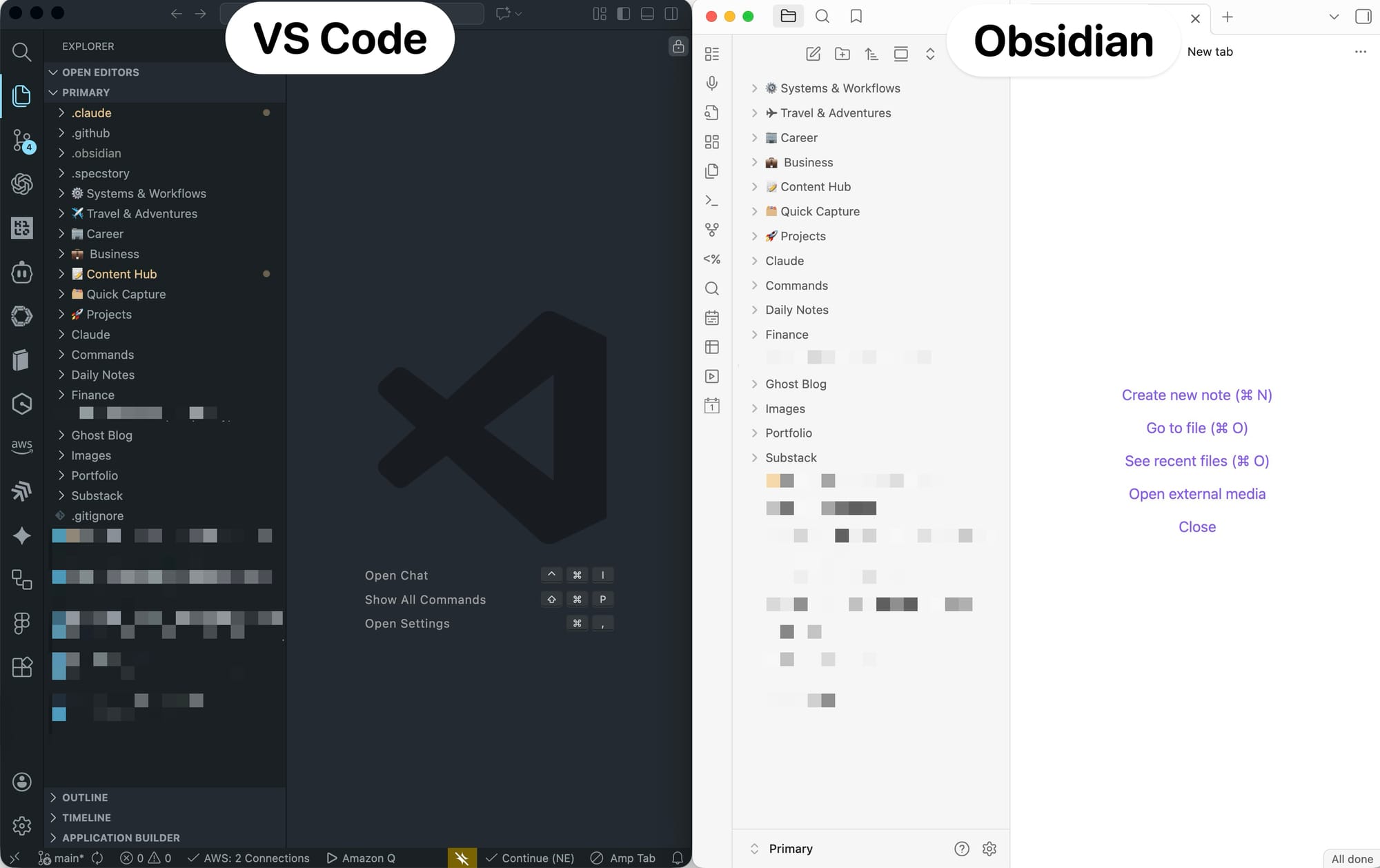
Before AI + Obsidian, these lived in fragmented silos. Notes lived in Apple Notes, Craft, Obsidian, Google Docs, and Notion. A half-finished doc there. Ideas that never connected.
Obsidian became my second brain. Claude Code became the bridge between thinking and doing. Together, they created a feedback loop between ideas and execution.
Here's how it works:
- Capture: Quick notes, voice memos, and random thoughts go into Obsidian
- Connect: AI helps me see patterns I'd miss—linking a design system's insight to a content idea to a workflow optimization
- Execute: Claude Code turns those connected ideas into actual artifacts—blog posts, scripts, analyses, prototypes
- Learn: The outputs feed back into the system, creating new connections
Building infrastructure for how you think. Here's where it gets weird:
The recursive insight that broke my brain:
The Obsidian system I built to document my learning projects became the mechanism for understanding systems themselves.
I started tracking:
- Which projects I shipped or abandoned
- Which tools I kept or discarded
- Which workflows saved time or created friction
- Which insights are connected to other insights
That tracking—that telemetry—taught me more about building effective systems than any individual project did.
The system for learning became learning about systems.
This is what design systems practitioners know intuitively: you don't understand a pattern until you've observed it across multiple instances.
Now I see telemetry everywhere:
- My content system shows which topics resonate
- My workflow automation reveals where I'm still creating manual bottlenecks
- My knowledge graph exposes which ideas are isolated or well-connected
Obsidian is infrastructure for observing how I think.
And observing how you think changes how you feel.
Lesson: Build systems with telemetry. Then let the telemetry teach you about systems.
Becoming a Builder
My design systems background trained me to see systems holistically. Components don't exist alone—they're part of hierarchies, relationships, constraints. Good systems are:
- Modular (pieces that work independently)
- Composable (pieces that combine predictably)
- Scalable (patterns that hold up under growth)
In 2025, I realized these same principles apply to everything I'm building with AI.
I'm building systems:
- A content system that connects ideas → drafts → published pieces → repurposed snippets
- A knowledge system that captures what I learn and makes it retrievable
- A workflow system that automates repetitive work
- A portfolio system that showcases work at multiple levels of depth
AI gave me the execution capability to match the vision.
What I Actually Built in 2025
A year of shipping.
Infrastructure I Can Own
Ghost blog on EC2 – Migrated from Substack. Learned AWS, CloudWatch monitoring, secrets management, and cost optimization. Now I control my content infrastructure.
CloudFlare integration – Because owning infrastructure means understanding how it's delivered.
Tools That Extend My Reach
Figma plugins – AI API integrations that bring LLM capabilities into design workflows.
Chrome extensions – Automating repetitive browser tasks.
iOS apps – Google Maps API integration, learning mobile development patterns.
Connects to: Lesson 1 (permission to not know)
Workflows That Compound
Linear → Obsidian → Claude Code → Content pipeline – Tickets become notes, notes become drafts, drafts become published content. The system feeds itself.
Context-switching intelligence – Learned when to use Gemini vs Claude vs specialized tools based on task type.
The Tool Journey (Divergent → Convergent)
Explored broadly: Cline, Jules, AWS Builder/Q, Kilo, Tinker, Replicate, Recraft, RunwayML, Mermaid, Spec Story, Manus
Narrowed to essentials: Claude Code, Gemini, Ghost, Obsidian, Linear
This wasn't random—it was applying design thinking's double diamond to my own tool stack. Go wide to understand possibilities. Converge on what actually works for my workflows.
Portfolio with Motion+ and GSAP
Built my portfolio site leveraging frameworks I've long admired. AI helped me learn animation libraries I'd been intimidated by.
The Meta-Insight
Building the Obsidian system to track all of this became the learning itself. I was building telemetry for my own growth. The system taught me about systems.
What This Foundation Means for 2026
Three years of building created a platform for compounding growth.
Learn skill → Apply skill → Hit ceiling → Learn new skill → Repeat.
That was the old model. The new one: Build system → System generates outputs → Outputs create opportunities → Opportunities feed back into system → System evolves.
How I'm Building on This
Three years of building created momentum that maintains itself.
The systems I built in 2025 generate new opportunities. The content system produces ideas. The knowledge system reveals patterns. The workflow automations create time for deeper work.
Letting the systems evolve naturally.
The Content System Matures
The pipeline is built: Linear tickets → Obsidian notes → Claude Code → published content.
Now I shift from infrastructure building to volume production. The system works. Time to run it hard. More public writing. More case studies. More teaching what I'm learning in real-time.
Not a goal: "Publish more."
The reality: The system naturally produces content; I just need to stop bottlenecking it.
The Technical Foundation Deepens
Every project reveals new gaps worth filling:
- Cloud architecture patterns (running real infrastructure)
- API design principles (building integrations)
- Automation engineering (eliminating manual work)
Building exposes what's worth learning next.
The Playbook Gets Documented
The best way to clarify thinking is to teach it.
Everything I've learned—about AI as thought partner, about building systems with telemetry, about permission to not know—gets written down as a living document that evolves with practice.
The Systems Scale (and Simplify)
Automate what works manually. Adapt what works for me so it works for others. Double down on what's unique.
The natural next moves when a system is working.
2025 built the engine.
2026 runs it.
For Designers, Builders, and the Curious
If any of this resonates, here's my honest advice:
Start before you're ready. The gap between "know enough" and "know enough to start" is a lie we tell ourselves.
Build systems, not one-offs. Every project should teach you something you can use again. Compound your learnings.
Document everything. Your future self will thank you. Your audience will benefit. And the act of documentation itself crystallizes understanding.
What are you building that's teaching you about building? I'd love to hear your story. Connect with me on LinkedIn!